

On May 19, 2026, the Department of Economics, Entrepreneurship and Business Administration at Sumy State University hosted the international scientific and practical conference “Economics for Ecology”, organised with the support of international projects co-funded by the European Union.
The conference brought together more than 50 participants, including academics, young researchers, PhD students, and students interested in sustainable development, ecological transformation of the economy, innovation, and European approaches to science development. Registered participants received certificates of participation.
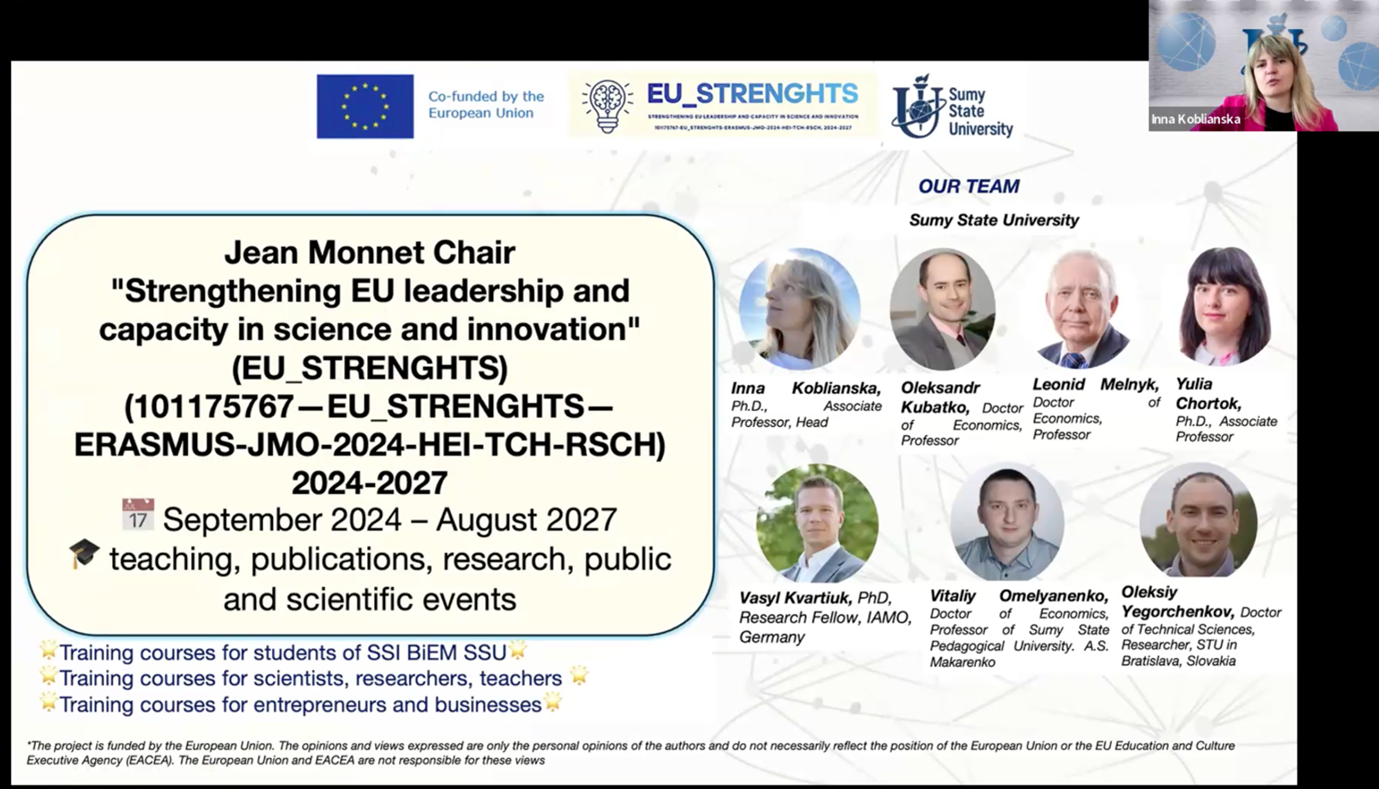
During the conference, Inna Koblianska, the coordinator of the EU_STRENGHTS project, presented the project’s results and activities implemented in 2024–2026 to the participants.
A special focus of the conference was placed on presenting research conducted by young scholars of the Educational and Research Institute of Business, Economics and Management of Sumy State University. Students and PhD candidates delivered presentations on digitalisation of business processes, sustainable energy development, EU environmental policies, circular economy, post-war recovery, and other pressing challenges of modern development.
The conference also provided a platform for discussions on interdisciplinary research, the role of innovation in achieving sustainable development goals, and the importance of international academic cooperation in shaping a modern research environment.
Such initiatives demonstrate the practical implementation of the EU_STRENGHTS project mission – strengthening science, innovation-driven thinking, academic leadership, and the involvement of young researchers in the European research area.
Jean Monnet Chair «Strengthening EU Leadership and Capacity in Science and Innovation» (101175767—EU_STRENGHTS—ERASMUS-JMO-2024-HEI-TCH-RSCH) 2024-2027. Funded by the European Union. Views and opinions expressed are however those of the author(s) only and do not necessarily reflect those of the European Union or the European Education and Culture Executive Agency (EACEA). Neither the European Union nor EACEA can be held responsible for them