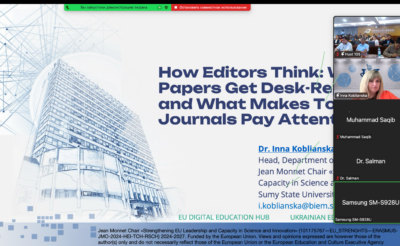

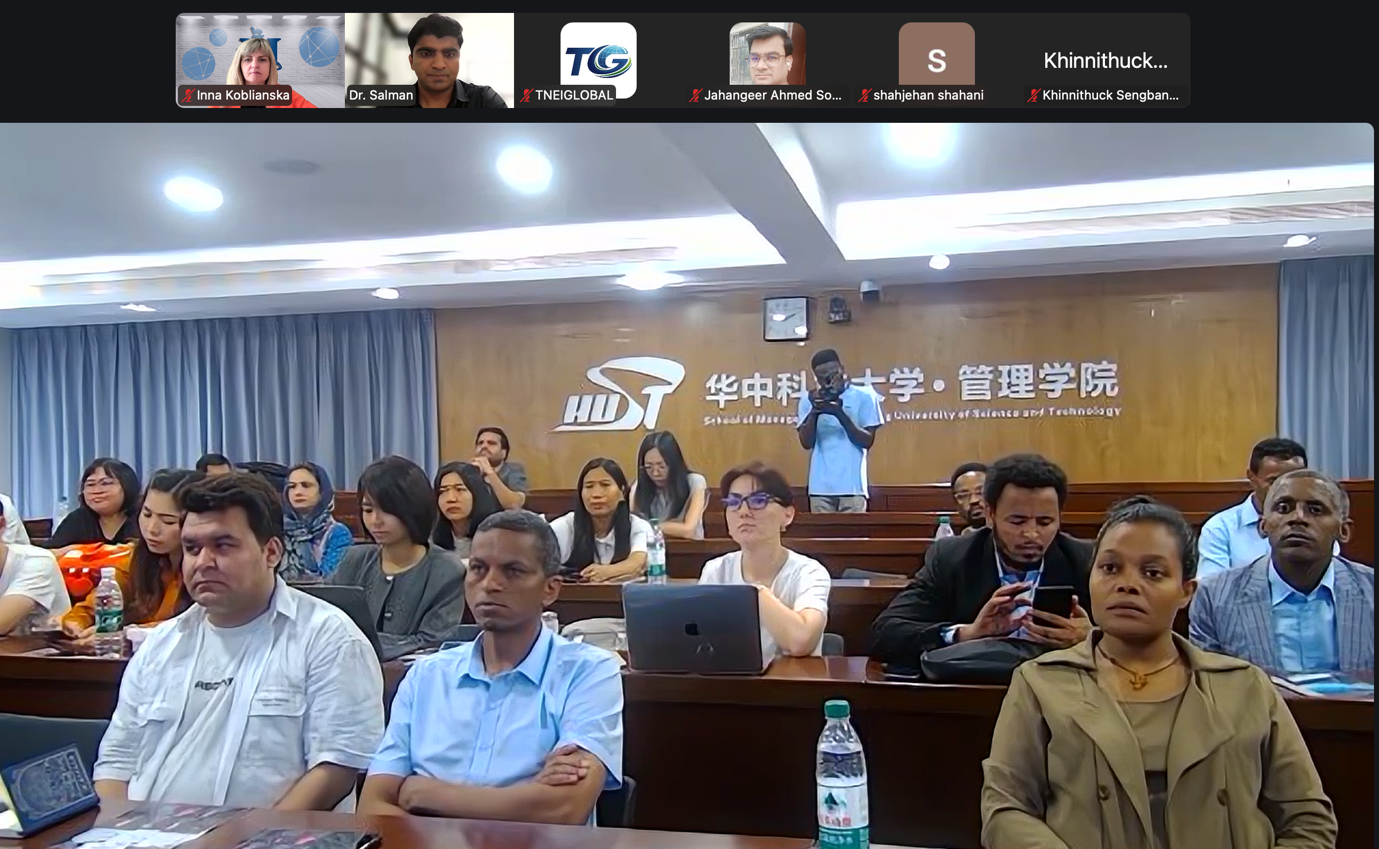
On June 25, 2026, the outcomes and expert insights of the Jean Monnet Chair “Strengthening EU Leadership and Capacity in Science and Innovation” were presented to the international academic community during the online event “The Road to Dubai: Pre-Conference Research Accelerator & Publishing Masterclass 2026”, hosted by Huazhong University of Science and Technology.
During the event, Dr. Inna Koblianska, Head of the EU_STRENGHTS project, Associate Professor, and Head of the Department of International Economic Relations at Sumy State University, participated as a keynote speaker with the presentation “How Editors Think: Why Papers Get Desk-Rejected and What Makes Top-Tier Journals Pay Attention.”
The presentation addressed one of the most pressing challenges in modern academia — publishing research in leading international journals. Participants explored the hidden reasons behind editorial desk rejection, evaluation criteria used by editors and reviewers, and the factors that shape the scholarly value and international competitiveness of research.
Special attention was paid to the development of research competencies, academic leadership, and the capacity of scholars to integrate effectively into the global scientific community. These areas are central to the EU_STRENGHTS project’s mission to strengthen the role of European approaches in advancing science and innovation in Ukraine.
Participation in international academic events of this scale not only promotes the dissemination of project outcomes but also creates new opportunities for intercontinental dialogue, professional networking, and the exchange of best practices among representatives of Ukraine, the European Union, and Asia.
Jean Monnet Chair «Strengthening EU Leadership and Capacity in Science and Innovation» (101175767—EU_STRENGHTS—ERASMUS-JMO-2024-HEI-TCH-RSCH) 2024-2027. Funded by the European Union. Views and opinions expressed are however those of the author(s) only and do not necessarily reflect those of the European Union or the European Education and Culture Executive Agency (EACEA). Neither the European Union nor EACEA can be held responsible for them.