
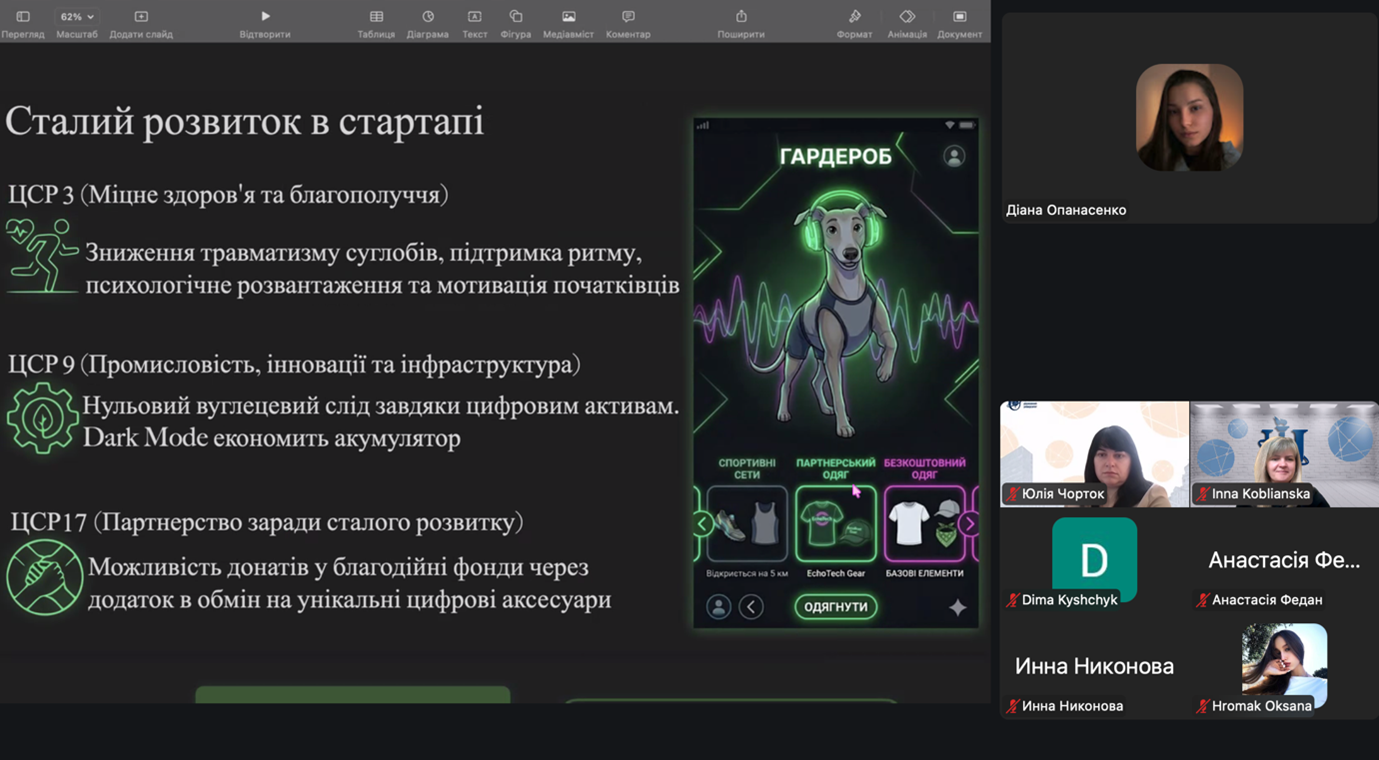
On 4 April, a start-up pitching session took place, featuring projects developed by students of the Institute of Business, Economics and Management within the course “Innovative Entrepreneurship and Start-up Management: EU and Ukraine Experience”.
The course is implemented within the framework of the Jean Monnet Chair project “Strengthening EU Leadership and Capacity in Science and Innovation” (EU_STRENGTHS) and is aimed at developing entrepreneurial thinking, innovation competences, and understanding European approaches to the development of start-up ecosystems.
The course is taught by Inna Koblianska, PhD in Economics, Head of the Department of International Economic Relations and Project Coordinator, and Yuliia Chortok, PhD in Economics, Associate Professor of the Department of Economics, Entrepreneurship and Business Administration. A total of 121 students of the Institute of Business, Economics and Management participated in the course.
During the pitching session, students presented innovative solutions aimed at addressing socially significant challenges, including:
– adaptive clothing design for people with special needs;
– a mobile application for people with hearing impairments;
– a book-sharing platform;
– other interdisciplinary projects at the intersection of technology, social innovation and sustainable development goals.
Participation in the development and presentation of start-up projects contributes to the development of students’ innovation thinking, teamwork, public presentation skills, and entrepreneurial approaches to addressing societal challenges, which corresponds to European approaches to innovation and entrepreneurship development.
Jean Monnet Chair «Strengthening EU Leadership and Capacity in Science and Innovation» (101175767—EU_STRENGHTS—ERASMUS-JMO-2024-HEI-TCH-RSCH) 2024-2027. Funded by the European Union. Views and opinions expressed are however those of the author(s) only and do not necessarily reflect those of the European Union or the European Education and Culture Executive Agency (EACEA). Neither the European Union nor EACEA can be held responsible for them.