

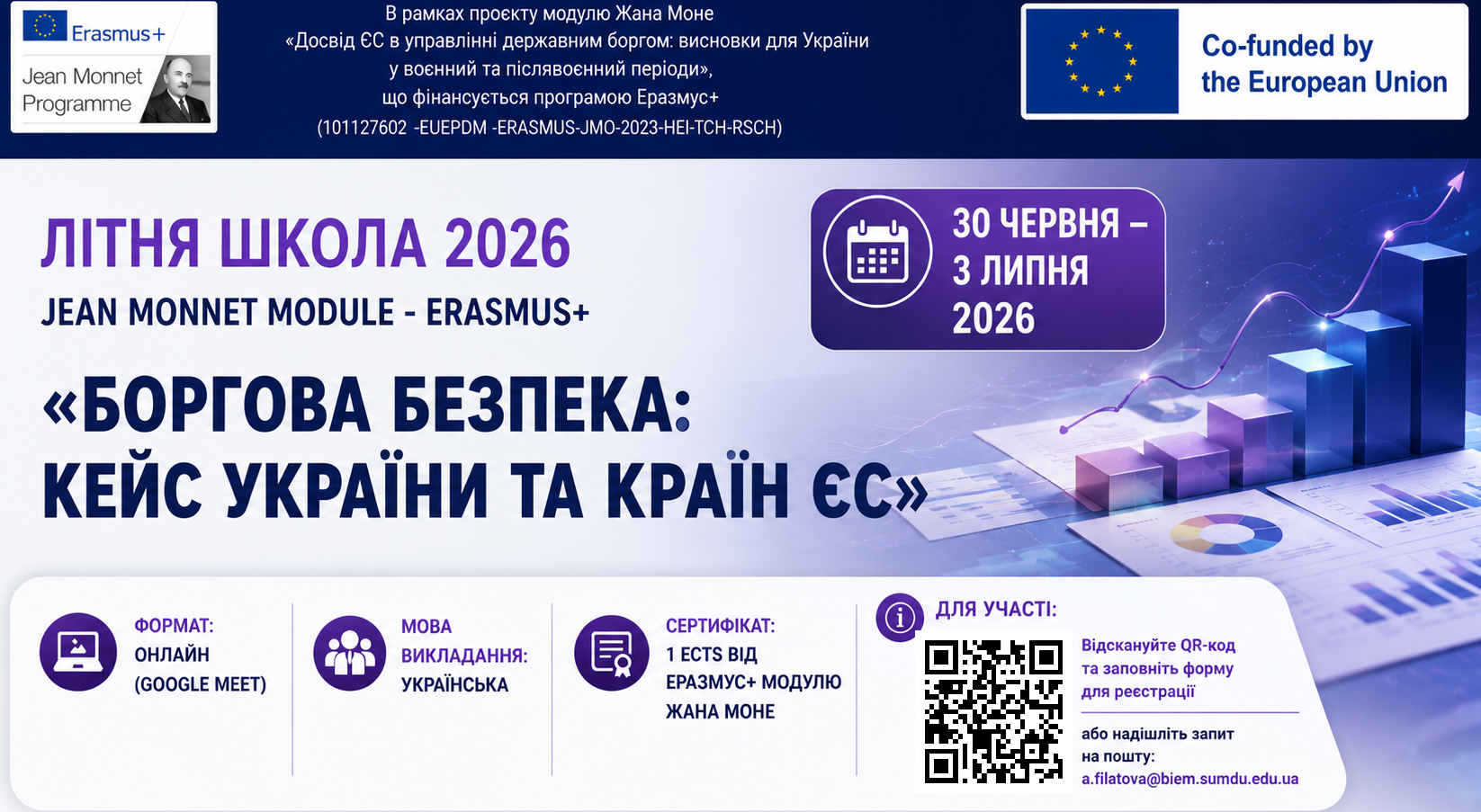
Attention! We are pleased to invite all who are interested to participate in the Jean Monnet International Summer School on «Debt security: the case of Ukraine and European countries», which will take place online from 30 June to 3 July 2026.
The cost of participation in the school will be covered by the Jean Monnet Module project «EU Experience In Public Debt Management: Conclusions For Ukraine In The War And Post-War Period» (101127602 – EUEPDM – ERASMUS-JMO-2023-HEI-TCH-RSCH), funded by the Erasmus+ program.
The Summer School aims to deepen participants’ knowledge of public debt security, examine current trends in the debt policies of Ukraine and EU countries, and develop practical skills in assessing debt-related risks and making informed decisions in the field of public finance.
Lecturers of the Jean Monnet Module:
- Olena Kravchenko – Associate Professor, Department of Accounting and Taxation;
- Nataliia Ovcharova – Senior Lecturer, Department of Accounting and Taxation;
- Hanna Filatova – Senior Lecturer, Department of International Economic Relations.
Language of instruction: Ukrainian.
Venue: Google Meet (online).
Upon successful completion of the Summer School, participants will receive an Erasmus+ Jean Monnet Module Certificate worth 1 ECTS credit, as well as access to presentation materials and other learning resources.
Registration is open via the following link: https://forms.gle/G4Ghhw6Swrf2Z4kL9
A registration form in a downloadable file format can be requested by email at: a.filatova@biem.sumdu.edu.ua
Detailed information, including the schedule and Google Meet links, will be sent to all registered participants using the email addresses provided during registration.
We look forward to seeing you among the participants of the summer school and are grateful for sharing this invitation!
Funded by the European Union. However, the views and opinions expressed are those of the authors alone and do not necessarily reflect the views of the European Union or the European Executive Agency for Education and Culture (EACEA). Neither the European Union nor EACEA can be held responsible for them.